.
Showing posts with label Blade Runner. Show all posts

Friday, December 23, 2011

'Blade Runner' Semiotics

Each of the main characters is associated with an animal.
Roy - is both a wolf and a dove,
Rachael - is connected to the spider,
Tyrell - Owl and
Deckard - to sushi (raw fish) and the unicorn.

Each creature also carries connotations of character:
Roy’s dove - a link to his final scene in which he holds a dove – a symbol of peace and often the soul, it flies from his hands when he dies.
Significance? the slow extinction of Earth’s natural animals and their replacement by replicants.
- Human fears replicants replacing all humans
- Or the preciousness of each individual, as once they are extinct (dead) nothing again will be exactly like them.
- In fiction,(for example His Dark Materials by Philip Pullman), the soul’s outward appearance often has that of an animal. The Point: Replicants have souls too despite their unnatural creation.


The chess game between Tyrell and Sebastian:
Uses the conclusion of a game played between Anderssen and Kieseritzky (London, 1851). It is considered one of the most brilliant games ever played, and is universally known as "The Immortal Game".
Symbolism?
- The concept of immortality 
- Represents the struggle of the replicants against the humans: the humans consider the replicants pawns, to be removed one by one. 
- Or it represents the game between Tyrell and Roy who is stalking Tyrell. 


Eye symbolism is also a key part of the narrative shown through images of:
    - The eye in the opening shots
    - Replicants' eyes glow
    - Tyrell has huge glasses to make his eyes bigger
    - Eyes are used in the VK test to examine pupil dilation and seek emotional reactions/lies
    - The first person the replicants go to is Chew, at the Eye Works, who makes the Nexus’ eyes. He says "Eyes, eyes... I do only eyes"
    - Roy replies "Chew, if only you could see what I've seen with your eyes!" 
    - Leon tries to stick his fingers in Deckard's eyes and Roy kills Tyrell by sticking his thumbs in his eyes
    - Roy says "I've SEEN things you people wouldn't believe” and "I wanted to SEE you"

The film’s theme, the quest for immortality, is linked to the ever-present eye motif:
- eyes are the windows to the soul, and only the soul is immortal 
- The replicants’ underlying humanity is displayed through showing their ‘souls’ in this way, as well as through their attachments to each other.   
There is also a lot of religious symbolism within the narrative. Roy, who is shown to have a dual nature, is shown on the one hand to be Lucifer and the other replicants are fallen angels because they were inherently benign creatures who became violent only through the neglect of a corrupt society. 
Roy paraphrases part of William Blake’s “America: A Prophesy” which supports the theory that the replicants are representing the fallen angels.
Roy:  "Fiery the angels fell, // Deep thunder roll'd around their shores // Burning with the fires of Orc." 
Blake: "Fiery the angels rose, // And as they rose deep thunder roll'd // Around their shores: indignant burning with the fires of Orc."


In the light of this idea the screenwriter plays with the idea that these human creations show us more about the ugliness of man then they do of the created.
On the other hand, Roy can be shown to be Christ. As he begins to cramp and die Roy puts a nail through his palm – a symbol of crucifixion. The society was not ready for replicants on Earth and so programmed them to die after only a glimpse of the world. When Roy dies it is a release from his torment. 

Tuesday, October 11, 2011

'Blade Runner' Costume and Type-Casting

Costume:

Deckard’s style of dress:
- conforms to that of a stereotypical American detective
- resembles styles from the ‘40’s and 50’s.
- brown trench coat and coloured shirt and the way his weapon is holstered at the hip, have connotations of a Western ranger.
- old fashioned compared with the advanced technology his world.
- Deckard’s weapon although advanced in function has a retrofit look.
- generally dark or duller colours = highlight his skill for blending in.
constant motif of darkness 
- tie a symbol of professionalism, but rather than creating a sleek image for Deckard his mismatched ties show a certain scruffiness and, like the rest of his outfit, practicality.
- Over the course of the film Deckard’s appearance becomes more dishevelled, particularly directly after the fight sequences where his number of injuries are also increased.

Type Casting: Deckard’s character
- strong and silent
- moments of intense emotion (For example, the kiss scene and the final climatic fight).
- appearance connotes to strength to make his conflicts with the replicants seem plausible
- double layering of the trench coat, with its large collar and the jacket create an enhanced shoulder size and emphasise Harrison Ford’s height.
- Male protagonist chosen for this reason too,
- aggressive and emotionally detached.
- mid-brown hair and lack of distinct facial differences create the image of an ‘Everyman’ that the audience can relate to and follow.


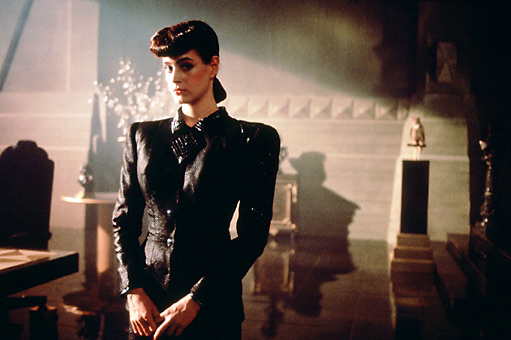
Rachael’s style of clothing:
accentuates not just her femininity
- also creates the implication that she is an android due to some of the angular lines.
- shoulder padding, use of straight lines and rigidly set hair highlight her perfect proportions.
- her demur outfits share likenesses in style to those from forties Films Noir particularly with the use of black.

**The film has acknowledged the cyclical nature of fashion but they have also altered the richness of those classic outfits to make them more rigid and mechanised.**
- high-heels are a female icon but Rachel's characteristic rhythm on the floor at Tyrell Corp. denotes to the seemingly cold and reserved side of her character. Later this sound is used to symbolise her power as she chooses a new path of her own.- Rachael’s clothing transforms, following her personal development.
- A voluminous fur coat, which has a high, stiff collar that frames her face gives her an edge of softness but also takes on an animalistic look when she kills Leon.
- the colours of her outfit  soften to a light, silk grey girlish dress with horizontal stripes and a small bow.
- most significant change in her appearance is when she lets down her hair. Her messed up curls soften her angular face and create a sense of her vulnerability. Here, with more natural make up (without the dark eyeliner and the bright red lips) she looks less like a porcelain doll and more human, ironically this is when she accepts the truth that she is a replicant.
smoking, perhaps indicating her deep need for something to rely on but also it gives her an air of mystery as often the tendrils smoke hide or blur her face.

 
Type casting: Rachel's Character
- exceptionally dark hair make her stand out from the two other women in the film, 
- highlighting her internal differences externally, 
- perhaps implying that she is ‘the dark horse’ of the film – the unexpected survivor/winner. 
- Her appearance is to exploit her beauty and present her as a desirable character. 

 
‘Blade Runner’ is a cyberpunk vision of the future and for this reason the style of the replicants (who are treated as a subservient lower class) have costumes that reflect their status.
 
Roy’s Style:
- black and grey scale clothing
- a long, reflective coat-  resembles waste. This is to convey the consumerism and post-industrial fashion of the predicted 2019.
- the coat also resembles Deckard’s with its large collar and, like Deckard’s, is worn mainly for concealment.
- the leather jacket allusion has connotations with rebels even in our society.

- Black in clothing also creates an impression of size and on Roy, who is an A grade physical model, it emphasises his size and potential strength
- creating a very imposing image.
- In contrast with the darkness of his clothing Roy has practically white hair and incredibly blue eyes
-  In the final fight scene, Roy removes most of his clothing and strips to just a pair of black shorts.
In doing so he removes the restrictions society has placed upon him becoming wilder and more animalistic in his attack. However, at the very end before his death, Roy’s near nakedness could be to imply that he was still a child (not yet 4 years old) and return him to a state of vulnerability and innocence.  The rain in this scene washes the blood from him, cleaning him, which could also support this idea.  
 
Type casting: Roy's Character
Rutger Hauer as Roy Batty
- showed both the good and evil within his character
- balanced the violence of Roy with his powerful reflections.
- The appearance of the replicants who are supposed to be superior to humans should be that of physicality, beauty and danger.
- Roy’s image is cold, Aryan and flawless in order to highlight his power,
- Tyrell even describes him as the “prodigal son”.
- The actor’s strong features and large eyes draw focus to Roy’s intense emotion. 

'Blade Runner'

Blade Runner (1982),            Director: Ridley Scott             Genre: Drama, Sci-Fi, Thriller

‘Blade Runner’, loosely based on the novel ‘Do Androids Dream of Electric Sheep?’ by Philip K. Dick, depicts a dystopian Los Angeles (set in a prediction of what 2019 could be like) in which genetically engineered robots, eerily referred to as ‘replicants’, exist within the workforce. The use of the word ‘replicant’ the essence of which comes from ‘replicate’ highlights the organic nature of these robots and that they are virtually indistinguishable from humans, able therefore to even replace them. However, they have superior strength, agility and variable intelligence which caused the use of replicants on Earth to be banned and so the Tyrell Corporation manufactures the replicants only for dangerous, menial or leisure work on Earth's off-world colonies. It is the job of Blade Runners to enforce this ban by hunting down and ‘retiring’ replicants who breach this law. The plot follows Blade Runner, Rick Deckard, as he takes on a final assignment to hunt down four recently escaped replicants.

‘Blade Runner’ is often considered part of the neo-noir genre, which means it draws its styling from films noir, typically American crime dramas or psychological thrillers, from the ‘40’s and ‘50’s. Conventions such as protagonists who are conflicted antiheroes, trapped in difficult situations and making choices out of desperation or within a corrupted moral system (moral nihilism). Visual elements include low-key lighting, artistic use of light and shadow for effect and usual camera placement.
The Title: ‘Blade Runner’ refers to the nickname given to people who work for a special branch of the police organisation and use the ‘Voight-Kampff’ machine (an advanced lie detector) to discover replicants. This title is now iconic because of this cult classic film, however it was actually taken from Alan E. Nourse, who wrote a book called ‘The Bladerunner’ but this is where any similarities end.
The Tagline: “Man has made his match …Now it’s his problem.” This highlights one of the main messages of the film that man is the antagonist as much as the replicants. The society of 2019 created these robots and treated them as an underclass when they were manufactured to be as similar to humans as possible. The idea of this questionable morality sets up the tone of the narrative. The ambiguous ‘his’ could relate to mankind as a whole or merely the protagonist or even the replicants. This also connotes to the seeking of personal and human identity, a prominent goal within the thematically complex film. The tagline may even go further to present the audience with a moral choice, whether or not to condemn man for the problems that unfold within the film.
Characters:
The protagonist Deckard (Harrison Ford) is an ex-Blade Runner and it is his fight against the replicants and story of moral discovery that the audience follows. He acts as a human comparison with the replicants and means to show that they are not so very different. There are many parallels that can be drawn between him and Roy (the leader of the rebelling replicants) not least their original aggression and violence followed by emerging sensitivity and understanding. These similarities ask the audience the question ‘what does it mean to be truly human?’ In one version of the shooting script the film ends with a voice over where Deckard says “I knew it on the roof that night. We were brothers, Roy Batty and I!” highlighting that Deckard has come to the understanding that the replicants are not just alike physically to humans but have learnt and become the embodiment of what it is to be human – in essence this is shown through their fight for survival and Deckard’s awakening to the value of life. This over voicing has also led to speculation over whether Deckard himself is a replicant, supported by the theory that only another replicant could take the beatings that Deckard does and survive,  thereby shocking the audience and revealing that there is no difference between the replicants and humans as the audience could not have guessed at  Deckard’s origin.
Rachael (Sean Young) is an experimental Nexus 6 replicant who has been imbued with the memories of her creator’s niece. Her significance to the narrative is that she awakens Deckard’s sympathetic character, rekindling in him an ability to love and appreciate unique human qualities. This is ironic as she is a replicant who is able to bring out Deckard’s human and emotional characteristics where other humans had made him suppress them. Her presentation as a fem fatale is supported by her composed and assured manner making her appear cold and at times indifferent. Outside of the Tyrell Corporation and after her discovery of her identity she develops more as an emotional character as she explores herself to try and find the human within. Other than a role as a love interest she is also pivotal in the ‘replicants are equal to humans’ debate and furthers the theme of self discovery within the film. She also challenges Deckard as to his views on replicants and plants doubt as to his human status, asking “Have you ever taken that test yourself?” of the VK replicant lie-detector.
Roy Batty (Rutger Hauer) is the leader of the four renegade replicants that have returned to Earth to seek out their maker. The themes behind their story and motives highlight, ironically, the human condition –to want to live (“I want more life, father!”). There are links to many classic texts behind their story, most notably ‘Frankenstein’ where the creature, neglected from birth, seeks his maker to ask one request. Also, Roy’s often violent and extreme actions, he kills his maker by gouging out his eyes, can be viewed as the resulting actions of his enslavement and life lived in fear of death. Roy is extremely intelligent, strong and powerful. He uses his superior skills to manipulate and control the humans around him in pursuit of his goal. Ironically, the passion and aggression with which the replicants fight to survive only impresses further how human their reactions are. Roy is shown to have a Romantic soul, which we see through his love for Pris and grief at her murder and also his reflection on life, “I’ve seen things you people wouldn’t believe… All those moments will be lost in time, like tears in rain.” Although initially the antagonist of the narrative Roy’s journey and conclusion transform him into a noble and heroic figure (when he allows Deckard to live). The character of Roy is exceptionally deep and brings to mind the saying “one man’s terrorist is another man’s freedom fighter” – if the story were told from the position of the replicants he would have seemed a tragic hero from the start.
Dr. Eldron Tyrell (Joe Turkel) owns the Tyrell Corporation which manufactures the replicants. He is extremely intelligent and designed the Nexus 6 brain. His character role is one of the scientist who plays God or Creator within the film. The actual antagonist of the film, as it often is in dystopian futures, is the society. Tyrell is a representation who embodies the values of capitalism and ideas of morality held within the film world of 2019. It is alluded to that Tyrell is a chess champion and therefore the narrative of the film could be viewed as an experiment of which he is initially the master but later loses control. If a viewer comes to the conclusion that Deckard is a replicant it could, by extension, be that Tyrell has been moving Deckard and Rachael to be his own Adam and Eve (as the first replicants with human memories). Tyrell seems unable to see his mistake and that he brought about his own death. He endowed the replicants with intelligence, super-human strength and the ability to develop human emotions and yet made the slaves to the ticking clock with only 4 years of life. He says, “The light that burns twice as bright burns half as long … and you have burned so very, very brightly, Roy.” comparing his creations to stars, inanimate objects. Tyrell doesn’t see them as human and arrogantly assumes that they should be grateful for whatever life they have been given. He is an unsympathetic character.

Friday, October 7, 2011

'Blade Runner' Key Shots

What is most interesting about the title was that it appears over a dramatic shot which then fades away leaving just the title on a black screen in order for it to stand out.
The use of a striking close up, half in light, half in darkness is displayed here and has many symbolic connotations, particularly for complex characters. Roy’s character veers between evil acts and, if not good then, sympathetic intentions and motivations.
This image is of one of the replicants punching through metal in a moment of fury and violence. The container releases a large plume of smoke, under the cover of which the character escapes. The banging of his hands is synchronous with a raise in tempo and volume of the music giving the moment tremendous power.
This shot was particularly interesting. The protagonist jumps down and lands  running towards the camera, pulling up short and for a moment the audience is allowed a clear view of his facial expression during a sequence that had been fast paced music. In the trailer this shot cuts to black and silence so the audience’s thoughts linger on this image.

'Blade Runner' Action sequences (Trailer)

Action is one of the principle genres of this film and something that comes across strongly in the trailer. There is a sequence of a woman (one of the replicants) running down a busy, dim, but neon lit street and smashing through a pane of glass. This image is shown from a number of different angles and at one point is shown in slow motion to heighten the drama of the moment. The smashing sound also is loud and emphasises the impact.

Other short action shots are cut between at an increasing pace, for example Deckard being throw around, jumping through the air, chasing his opposition and (for the final shot) screaming in pain. However, these action shots are given tension and meaning by the images that build the layer of threat around each of the characters. Back lighting is used three times on Roy, once from a low angle to create a sense of intimidation and apprehension. The line “Prepare to die!” is heard over the scene where Deckard is being held by one of the replicants (Leon) and images of Deckard armed and wary, and injured create unease and mystery to further entice the audience.

'Blade Runner' Trailer Deconstruction

At the start of the trailer the black screen with green neon writing that reads “Los Angeles 2019” spells out the location and time frame for the audience. Setting the narrative in L.A, a frequently used city within films because of its iconic look was particularly clever because it allows the audience to make a direct comparison with the L.A and social climate they are used to. Throughout the trailer there are a number of aerial establishing shots, always at night, to create a sense of the new architectural landscape of a retrofitted future.  The skyscrapers are emphasised by their large lit windows and yet the darkness hides the details of the building making the landscape at the same time monotonous and non-descript – only the Tyrell Corporation building is focused up in one of these shots. The aerial shots also give the opportunity to show the Spinners (flying cars) and highlight the technological development of the era and futuristic diegesis that is the backdrop of the plot.
Technology is also highly emphasised. In the initial shots of setting and protagonists definitions of key words are used to introduce the audience to the Sci-fi reality of the film and immediately create contrast between characters through the use of binary opposition. TV static and a grainy or flicker effect are often used either as transitions or to distort images during the trailer. These effects only enhance the technological elements of the narrative.
The trailer uses a number of fade transitions to allow on glimpses of both the action and the moments of high emotion. Character is shown to be crucial as within the first couple of shots both the main characters have introduced themselves. Hints of character development are given but not enough to give away the complex plotlines, for example romance is hinted at for more than one couple. However, the main focus of the trailer is the protagonist verses antagonist relationship. Although there is a character that physically takes the antagonistic stance (Roy) to our protagonist, Deckard, poignant lines of dialogue voice over situations and give an implication of some larger evil at work, “more human than human is our motto” (Tyrell) and “Will you help us?” (said by the supposed opposition).
The trailer is also littered with motifs and symbolism hinting at the deeper questions being asked within the story. The use of light and dark contrast, a neo-noir style, mirrors both the internal and external battles in the characters and story. Close up shots frequently light only half of the characters faces in order to intimate this. The appearance of the locations visited and lived in by the protagonist continue this styling, and few moments are properly lit – even fewer are lit by daylight, to highlight the immorality and corruption of this new society. The scenes that are lit then stand out against the backdrop of darkness which helps to build tension and mystery, whilst creating a grungy environment for the social crimes to take place in.
There is an eye motif, both in the film and trailer, which can be interpreted in many different ways. The idea of being watched could be intimated, particularly whilst contemplating the extreme close up of an eye, but the question is: who is watching who? Some people would even say the eye that fills the screen is ironically the eye of God, watching the violent and tragic events unfold.
The obsession of most characters within the film is the basic human instinct of survival. The trailer builds the tension throughout the one minute to imply the threat of death to most characters; this ambience is paralleled by the ominous, orchestral non-diegetic sound which creates jumps through large crashing sound bridges synchronous with crucial moments of action. However, the use and power of silence has not been left out. The silence allows a protracted pause in between the fast paced trailer and elevates the sense of suspense and also acts as ‘the quiet before the storm’ and increases the impact of the loud noise straight afterwards, the jump near the end. 
The red anchorage in the title typography appear approximately half way through the trailer and read “From Director Ridley Scott” (who at the release of this newer trailer had gone on to become a large name in the film making industry and would draw appeal not only from his initial fans but also attract others. His name adds creditability to the film and is one of the movie hooks). Following the title the anchorage says “The Film That Started It All” which creates an antiquity to the narrative and implies its classic and important status in film history.

'Blade Runner' Webpage Deconstruction

As an older film, the webpage is more recent and was made to coincide with the film’s ‘Final Cut’ re-release. The main page loads with the red light icon used in the VK replicant detector test and pulses as it counts up to 100. The idea behind the scenes and graphics of this webpage are to further immerse the audience into the world of the film.
As soon as a page appears the Final Cut teaser trailer begins to play. Ever present in the upper left hand corner is the iconic title as a reminder to familiarise the audience with the brand. By clicking on this at any time, the viewer can return to the home page.
The background of the main menu page is an establishing shot of the city into which flies a Spinner (flying car). The sound that plays over this scene is dramatic music from the soundtrack and important dialogue pulled from the film.

By pulling the curser over the skyscraper the consumer is able to find the menu, the options include:
THE FILM: -Product Info, History, Synopsis and Ridley Scott
CAST & CREW: - Cast and Crew
GALLERY: -Downloads, Video and Photos
NEWS: -News, Events, Comic-Con and Newsletter
DISCUSSIONS and CONTEST: - 'Inspiring the future' contest (These two options open in a separate window.)
When selected the viewer is taken to varying scenes from the film. Moving the curser over the page the viewer can find objects which light up and by selecting these sub-categories (which are shown above) appear, often on a new screen, for selection. All this adds to the feeling of interaction and links to the technological aspect of the film.
THE FILM – Background: The Tyrell Corporation – conference room style, one must click on the desk to move to the next pages and read about the film.

CAST &CREW – J.F. Sebastian’s room full of mechanical toys where Pris is hiding as Deckard hunts her, click on the mirror to see the cast and crew information.

GALLERY –A still from the film, of Roy in the final fight scenes, in the screen of the VK test equipment, the image on the screen takes you to the gallery and the other areas available in this category.


NEWS –Again, this image is from inside the Tyrell Corporation. This room is used in the film as an interrogation suite. The perspective of the viewer places them in the shoes of the replicant being questioned. This is one way in which the Web-page creators have alluded to the film’s main question of humanity.


The ‘Discussions’ and ‘Contest’ give viewers the option to socialise with each other and connect with people who may have similar interests. The contest was a competition held in 2007 and was linked to the theme of the future. Along the bottom of each screen there is a link to add the page to your MySpace account and a ‘tell a friend’ option, as well as links to Amazon and ‘We store’ for purchase of the DVD and merchandise. This highlights the underlying importance of the website to advertise and well as to engage with the viewers.