.
Showing posts with label Universal Pictures. Show all posts

Tuesday, December 20, 2011

Universal Pictures International - Sales and Distribution Work Experience Part 2

I also spent the day at the Picture Production Company (PPC) which cuts and edits trailers and creates graphics and typography.
Before a trailer is made a Promo is edited.
- a video is a 3-8 minute outline of the whole film's narrative
- used to pitch the film.
- then condensed for a trailer according to a short brief written by the client.
Mostly editors have a lot of creative input and they select the clips either from ‘dailies’ (daily film reels whilst filming is still in progress), which is why things may appear in trailers and not in the final cut, or from a finished feature film, but this is uncommon.
I was told that the clients usually want to push their best bits into their trailer which is why trailers often end up showing too much. However, sometimes clients specify moments or narrative or characters which they wish to conceal. By reducing what can be shown the client and editor aim to tease the audience with enigmas.
The UK and Europe often have very different trailers to the US because they are more trusting in the intelligence of the audiences in the European markets. An example of this is ‘The Eagle’ trailer, which was released in both the US and the UK but whilst in production it was the US who wanted more text for narrative explanation.
When asked the editor I spoke with at PPC said that music was the most important component of a trailer.
He thought that bad trailer gimmicks were:
- overly quick cutting,
- not a lot of shots shown or narrative content and
- using lots of fades to black throughout the trailer.
All trailers, once refined, are checked by the certificating company who give input and ask for some things such as violence, swearing and smoking to be cut.
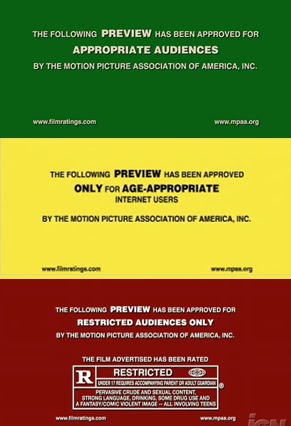
America have recently rethought the general green label for trailers, to show that they have been approved by the ‘Motion Picture Association’ and have introduced a red, possibly to be followed by a yellow, label to indicate that an internet trailer is “approved only for age-appropriate Internet users”. This is a way of identifying content that may be offensive such as violence, sex, language or trailer intensity.
Universal Pictures International - Sales and Distribution Work Experience

I went for a one week work experience placement at UPI, in London, in the Sales and Distribution area which works on the promotional packages and marketing for Universal films across the world, liaising with headquarters in the US and Japan.
The promotional packages include:
- all posters (Bus side, Billboard, Premiere, Cinema, 3D cardboard cut outs, Magazine, Character and Collector) and
- all trailers (Teaser, Theatrical, TV spots, Radio and Online) for each ‘territory’.
A ‘Territory’ is decided by language (and a poster/trailer’s need for translation/ subtitles/dubbing). For example, France is counted as 2 territories because parts speak Swiss-French and others Dutch-French.
The commercial process of creating posters has to conflicting objectives: CREATIVE verses LEGAL.
For contract reasons certain actors need to appear at certain sizes and with names in a certain order. Confirmation is needed from the Director and the actor before images can be used.
Each territory has poster preferences in order to create different social responses. See the examples from the 2010 reimagining of ‘The Wolfman’.
UK – Emily Blunt is a British star, Conventions of a supernatural Horror (eg. full moon, mist, forests, isolated vulnerable girl), monster is shrouded in mystery – one of the film’s hooks

French – Creates an ambiance of a thriller or mystery. The implication is that the narrative is sophisticated and character driven.
This poster (possibly Turkish) highlights the Romance element of the narrative and shows their relationship to be of importance. These actors may also be hooks to see the film.
Japan (which is the only country which Universal lets have complete creative control over their production material because Japanese culture is very different to the rest of the world)
 – This poster fits conventions of supernatural but the splashes of red have slasher connotations as well. However, the middle text actually explains most of the narrative (even one of the main plot twists) which implies that the story is in some ways prophetic.


This poster of ‘The Unborn’ (2009)  appears with a skirt on (in varying lengths) for some Asian countries, for example Malaysia.


Posters must conform to convention to indicate the genre but also subvert the viewer’s expectations and be in synch with the trailers, usually through colour or motif.
Feedback and revision of posters happens in small groups with the director, this is to gauge audience perception and the success of the work. [Cost is crucial to what can be produced.]
When I enquired as to what was considered a ‘bad poster’ the team suggested ‘floating head’ posters because they do not effectively convey anything except the actors who will appear in the film.

Each of these posters are for the same film yet show it from completely different angles.
UPI explained that different film angles sell better in different nationalities. For example, in Japan emotion is key, and in Asia explosions and action are popular.
Even in one country each poster series for a film may show it differently. Sometimes this is to attract different demographics.
For the demographics populations are divided into 4 categories:
In some countries posters may vary for social reasons. In the UK guns can appear on posters but cannot be pointing out of the poster. In some countries tolerance for nudity, guns and smoking is different and sometimes removed to avoid offense.