.

Wednesday, November 9, 2011

Recent Sci-Fi/ Thriller Releases

We researched recent Sci-Fi film releases in order to understand the style of films appearing on the market, understand the audience they are marketed at and the main themes being explored at the moment. Beside each title is a small break down of the themes or key points of the film.
Inception (2010) Action, Adventure, Sci-Fi/ technology exists to enter the human mind/ highly skilled thief/last chance for redemption/ inception = plant an idea/ layers of dream worlds/ discussion of reality/ ambiguous ending  
Tron: Legacy (2010)- Action, Adventure, Sci-Fi/ set in a cyber-world – created in the first film due to advances in technology, a sequel to the first Tron (yet their storylines overlap due to the change in protagonist), father and son bond, usurping the role of God leads to a corrupt cyber-society, use of doubles, 3D
Zenith (2010) – Sci-Fi, Thriller/ retro-futuristic steam-punk thriller/ 2 men in different time periods =parallel stories/ search for a conspiracy/ big questions - the meaning of humanity

(Angels and Airwaves) Love (January 2011) – Drama, Sci-Fi/ an astronaut/ stranded in orbit on the International Space Station/ loses contact with Earth/ claustrophobic and lonely existence/ battle to maintain sanity and stay alive/ makes a strange discovery…
Iron Invader (February 2011)- Sci-Fi/ Alien Bacteria infects metal/ giant killing robot/ merging of 2 categories of Sci-fi
I am Number Four (February 2011) Action, Sci-Fi, Thriller/ 9 Alien children hiding on earth/supernatural powers/ defenders of the planet/hunted- being killed off by another race of aliens seeking to destroy them
The Adjustment Bureau (March 2011) Romance, Sci-Fi, Thriller/ mysterious interfering fate/ worldwide link of portals/ a higher power that collaborates to control the lives of people on earth
Battle: Los Angeles (March 2011) Action, Sci-Fi/ Alien attack on an American city/ military action is taken
Mars Needs Moms (March 2011) Animation, Action, Adventure/ Aliens abduct the mothers from earth/ for children/ moral centre for the story
Limitless (March 2011) – Mystery, Sci-Fi, Thriller/ top secret drug/ struggling author/ it improves brain function/ drugs race/ ambiguous ending


Paul (March 2011) - Adventure, Comedy, Sci-Fi/ 2 British geeks in American take a road trip/ alien encounter/ choose to help the alien evade authority


The Tree of Life (May 2011) - Drama, Sci-Fi/ 1950’s/ exploration of the typical family unit/ psychological evaluation of the human condition/back drop admiration of the universe/ smallness of our lives
Source Code (April 2011)- Mystery, Sci-Fi, Thriller/ soldier/ inside the body of a dead man reliving his last minutes/ bomb on a train/ mystery/technological advancement/moral issues raised/ playing with time/value of life
X-Men: First Class (June 2011)- Action, Adventure, Drama/ the evolution of humans/genetic mutation/ prejudice against the new species/ conflict/ questions of good and evil in the possession of power – choosing sides/ prequel/team =protectors of humanity
Super 8 (June 2011) - Mystery, Sci-Fi, Thriller/ film within a film/ group of children/ alien attacking small American village/ investigations/ military involvement/secrets
2012: Ice Age (June 2011)- Action, Sci-Fi/ story of a family struggle/ environmental travesty/ desolation of the world as we know it – covered with snow/ global warming/ survival of humanity at risk/ apocalypse
Transformers: Dark of the Moon (June 2011) - Action, Adventure, Sci-Fi/ conspiracy on the moon/ giant robots/good versus evil/alien technology/ lost spacecraft/government cover-ups/world domination
Phase 7 (July 2011)- Sci-Fi, Thriller/ spreading pandemic/ quarantined building/ alliances and conflict/ human desire to live/protect his own/ protagonists aim is to protect his pregnant wife/ altruism verses selfishness –the human condition/ social commentary/global crisis
Alien Armageddon (July 2011) - Sci-Fi/ aliens attack earth
Attack the Block (July 2011) - Action, Comedy, Sci-Fi/ south London/ teen gang/ alien invasion/ unlikely forging of bonds/ human nature to stick together/exploration of subtle invasion not full on war
Cowboys & Aliens (July 2011) - Action, Sci-Fi, Thriller/ set in 1873/ combining the forces of cowboys and natives against a bigger threat/ aliens/ classic hero =has the power, technology to defeat the aliens/ amnesia =self discovery/ damsel in distress
Rise of Planet of the Apes (August 2011) – Action, Drama, Sci-Fi/ scientific experiments to find the cure for Alzheimer’s/ genetically enhanced chimp = uses intelligence to bring an uprising of his species/rebellion/ prequel/ father and son story
Apollo 18 (September 2011) – Horror, Sci-Fi, Thriller/ old footage style – merging past and present storylines/ 2 American astronauts sent on a secret mission to the Moon (Apollo 18)/ terrifying events
Real Steel (October 2011) - Action, Drama, Sci-Fi/ set in the near future/ robot boxing is a top sport/ an underdog story/ father and son story
Contagion (October 2011) – Drama, Sci-Fi, Thriller/ pandemic- deadly disease/ global crisis/ following an international team of scientists = the focus/ reality of the spread of disease and fear
The Thing (October 2011) – Horror, Mystery, Sci-Fi/ remake/ Antarctic research site/ discovery of an alien craft/ deaths and chaos ensue
In Time (October 2011) – Action, Sci-Fi, Thriller/ people have predetermined length of life/ they spend their ‘time’, the years of their life, as money for food etc./ the top few are young forever and immortal/ controlled genetics/ protagonist wrongly accused of a crime – on the run/ war against the system/ dystopian future
Melancholia (November 2011) – Drama, Sci-Fi / follows the strained relationships of 2 sisters/ new planet threatening to collide with Earth/ the human condition/ point of life
The Darkest Hour (December 2011) – Action, Horror, Sci-Fi/ set in Russia/ group of young adults struggle to survive/ alien attack
The Divide (2011) - Sci-Fi, Thriller/ survivors of a nuclear attack/ human survival / apocalyptic/ claustrophobic – stuck in a basement together/dwindling supply/ exploration of the power of fear
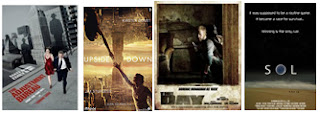
Sol (2011) - Sci-Fi/ distant future/ hostile alien planet/ Sol Invictus competition – Earth’s academics sent to distant planet and must pinpoint out the planet’s main sun ‘Sol’/ marooned on wrong island/ band together/ human survival – Lord of the Flies-esque
Recreator (2011)- Sci-Fi, Thriller/ robots/ trio trigger a deadly experiment of the ‘Recreator’ =a scientist with a gift for cloning/ must run from clones of themselves/ avoid being replaced
The Day (2011) – Drama, Sci-Fi, Thriller/ 5 survivors/ lost and on the run/Open war against humanity rages/ global/ survival and family story/ future collapsed society
The Hunger Games (March 2012) – Action, Drama, Sci-Fi/ Post-apocalyptic society/ corrupt powers/national games to the death held in the Capitol/ a boy and a girl selected from each district/ shown on TV - part of a larger method of control/ survival/ rebellion –refusal to conform
Looper (September 2012) – Action, Sci-Fi/A killer who workd for the mob of the future recognises one of his targets as his future self/ potentially like 'Minority Report' 


Gravity (2012) –Sci-Fi, Thriller/lone survivor/ space mission to repair the Hubble telescope/ attempting to return to Earth/ mother-daughter relationship 


Upside Down (2012) – Drama, Romance/ a man searches an alternate universe for a long-lost love from his youth 


World War Z (2012) – Action, Drama, Horror/ great zombie war/ interviews survivors
Prometheus (2012) - Action, Drama, Horror/ team of explorers/ origins of mankind/ travel to the corners of the universe/ battle for humankind/ prequel
Patterns:
More eclectic selection of storylines because Sci-Fi allows for more imagination – less restricted than other genres by convention/ sci-fi often operates outside of convention constantly surprising the audience
One of the main patterns we found in the releases was Space travel or the use of different or second planets – the Sci-Fi market is predominantly linked to the idea of space and space travel. This is represented through the numerous examples of films recently released that explore either the unknown depths of space, for example setting the narrative on an alien planet, or exploring human instinct and psychology through the claustrophobic and frightening atmosphere of space. Space is the perfect location for mysteries and thrillers as these genres rely heavily on the unknown and the unseen, which is provided in abundance. ‘Apollo 18’ is a horror set on the moon which taps into the human fear of the unknown and … In a way some of these films also exhibit elements of a dystopia. Looking at ‘Sol’ for example, set a little way in the future some humans occupy a hostile alien planet. The implication is that they have left Earth for some reason and yet have found themselves in a socially corrupt civilisation. The idea of some of Earth’s population being relocated is explored in ‘Blade Runner’ whose universe includes Earth’s off-world colonies. It projects the issues related to over population, lack of resources and advanced technology into the future.
War on a global or personal scale is something explored in a few of the most recent Sci-Fi’s. We can draw the conclusion that the fascination with the psychological and social effects of war is due to the continued struggles of many countries in the Middle East including Britain. These storylines revolve heavily upon the testing of the human spirit. This convention can be found in most Sci-Fi narratives because its universal appeal and scope to allow character development, for example in 'The Day'.
Another theme is Alien Invasion films where aliens attempt worldwide domination of earth but the storyline follows a small group of individuals. These films are classic alien narratives in use for decades, however in recent year’s comedy has been merged with this genre to create a new image for these films, for example ‘Attack the Block’ and ‘Paul’. ‘Paul’ is exceptionally different from the general storyline as he is the titular role and one of the sympathetic protagonists. The war genre is often found within the traditional narrative which creates tension and pace for the race for survival. Also uncommon is the 2011 film ‘Cowboys & Aliens’ which aims to subvert audience expectation by merging two almost conflicting genres.

Disease epidemics have within recent years been in the headlines. Filmmakers have therefore produced films such as ‘Contagion’ and ‘Phase 7’ to recreate the fear and crisis point that the media reported on during the outbreak of both bird and swine flu. Interestingly ‘Contagion’ follows the group of scientists trying to develop a vaccine as well as the human interest family story. ‘Phase 7’ is about the group of people trapped in quarantine and how desperation and fear can change people.
Technological and Robotic futures were made massively commercial by the return of ‘Transformers’ to the big screen. Films such as ‘Real Steel’ and 'Recreator' play on the idea of dramatically advanced technology and both the positive and negative implications of humaniod robotics. This is very similar in theme to 'Blade Runner' particularly the narrative of 'Recreator'. Advanced technology also feed heavily into dystopian futures.
Apocalyptic and Dystopian Futures or narratives present the highly charged conflict between self preservation and altruism. Apocalyptic narratives involve global catastrophes and the reactions of the characters to them, mostly these films are Action orientated initially. Environmental, War or Zombie are just a few examples of apocalypses that might occur within a narrative. The concept is that the breakdown of a civilised society creates friction and therefore a catalyst for anarchy and humans place within the landscape of a new world order.
Dystopian plots are about societies where life is not lived in the perfect situation presented and rebellion against the system, the way things have come to be, tends to be more low-key. A communist and violent future wracked with poverty is depicted in ‘The Hunger Games’ where the people are suppressed by a game in which a group of children must fight to the death each year. In ‘In Time’ time is no longer an intangible concept it is your value and currency. Each person must live by their time and pay their way with it but it is the poor who suffer and die so that the rich may live forever. Dystopian futures take modern concerns such as genetics, technology and government corruption to create an extreme future which suspends the audience’s disbelief and creates fear.
We have followed this trend, and our narrative will be set in a dystopian future and will explore a protagonists realisation and then rebellion against the corrupt system.

Social Stage Theory

“Social stage is the point to which the society of your hero has developed.” All societies evolve through distinct social stages and these influence the type of narrative seen within them. Each social stage becomes synonymous with a particular type of hero, a unique breed of opponent, special concerns and particular values that shape a plot. The significance of location design and placement is that it is indicative of character type and audience expectation.
Social stage can be used as an extended metaphor to examine humanity or to create a physical representation of how a person would deal with an internal problem eg. moral problems, as narratives generally have two antagonists –one internal (psychological) and one external (a person or problem).
Social stage is as much about relationships and making connections as it is about environment. Relationships powerfully shape the story and determine how a character will grow and develop. The family is a great power structure to explore and by emulating the hierarchy quality of a family into the society a story can provide a deeper connection between the protagonist and the society.
Raindance Film School teach that there are 4 key stages through which a civilisation would develop over time. (Obviously these can only be loosely applied and there are many exceptions to the stereotypes.)
1)      Wilderness and super-hero:
Ø  No buildings
Ø  Hero travels alone or with a band of followers (this setting lends itself to religious narratives)
Ø  Nature is vast and all-powerful
Ø  The protagonist ascends to the role of ‘Superhero’ because they are the only ones capable of surviving (They are always male)
Ø  ‘Barbarians’ are the antagonists and the main concern of the protagonist is to survive
Ø  Ending: the superhero leaves his group at the foot of a mountain (metaphor for the main problem) and ascends alone where he receives ‘divine gift’ which he will then share
2)      Village and the classic hero:
Ø  A village is a small settlement – all the buildings look the same and are one storey. Often fences and buildings will be under construction or in disrepair symbolising the broken barrier between barbarianism and civilisation.
Ø  There will be a simple social structure (young and developing) without hierarchy although one character will assume the voice of the whole village when talking to an outsider.
Ø  The village is surrounded by wilderness and is exposed to the forces of nature and the villagers are prone to attack. Villagers mistrust anything to do with the wilderness or anyone who is different from them.
Ø  The ‘Classic hero’ is almost exclusively male and either comes or is summoned from outside the village. Sometimes he is initially mistaken for the villain; however, he is their only hope for defeating the antagonist. The classic hero will have some useful talent that will save the fragile community that “cannot physically or morally handle themselves”.
Ø  Although the village will change during the plot, the protagonist remains the same in character during the film.
Ø  Warring between the protagonist and village characters in some cases reveals their wickedness and corruption. After the problem is dealt with the protagonist no longer has a place in the village society and leaves.
Westerns fit this structure but the example we have given below is ‘Sleepy Hollow’.
                                                                         Image [Left] , Image [Right]

3)      City and the average hero:
Ø  This is a developed village which, upon meeting a physical boundary, must begin to grow vertically. The city is a place of “hierarchy, rank, privilege and vast differences in wealth and power.”
Ø  The ‘Average hero’ is an everyman/woman –completely ordinary.
Ø  The pursuit of the average hero is often a nesting instinct to build/protect his/her home or family. They are concerned with equality and justice and avoiding “the slavery of bureaucracy and government”.
Image [Left] , Image [Right]

4)      Oppressive City and the anti-hero:
Ø  A city grows so dense, so technological and bureaucratic that it becomes a place of enslavement. Often the intention of those in power is to create a utopian society which in reality isn’t realised or becomes corrupted.
Ø  There is a large distinction between social classes –with large numbers of those who have little wealth or power and just a few with most of it.
Ø  An ‘Anti-hero’ can have 2 distinct traits. (1) a person who will not be “beaten down by the oppressive city” and is therefore exiled/witnesses a crime and then holds the key to keeping someone in power. This results in this citizen being pursued, often until death. eg. Blade Runner. Or (2) a person who is beaten down – incompetent or unsocial and comes to realise that his/her society is flawed.
Ø  The next development of society is for it to crumble, sometimes from its own corruption, other times from an uprising or rebellion –physically or through thought/awareness. Then this social stage completes its cyclical evolution and returns to a Wilderness state eg. Lord of the Flies.
The general trend is that as the social stage gets bigger the individual hero gets smaller (and often less powerful). Oppressed and futuristic often seem to be depicted hand in hand, often because people assume that our society of today is in the ‘City’ stage of development. However, by examining recent News and modern institutions it could be concluded that modern civilisation resembles many aspects of an ‘Oppressed City’ (although not to the extremes depicted in film.)
Below the example is ‘Nineteen Eighty-Four’.
Image [Left] , Image [Right]

We have decide that our narrative landscape is that of an ‘Oppressed City’ due to the dystopian features of our basic plot. We investigated the portrayal of cities further.
Conventions of portraying a cityscape in narrative:
Ø  Mirror or distort aspects of a city to fit the narrative.
Ø  Cities are organised vertically and power/wealth is often indicated through height and with extreme contrast. Eg. Penthouses and underground (subterranean) criminals. This creates narrative texture and these conventions lesson the need for explanation.
Ø  Cities divided into compartments preventing organised congregation and isolating people from one another allowing for “negative values of intrigue, secrecy and injustice” to be contrasted with the protagonists ‘nesting’ goal. The effect is highly impersonal and chilling in its coldness and detachment.
Reference:

Monday, November 7, 2011

Injury Make Up Research

 Black Eye:


Ø  Use 3-4 colours: Red (eg. plum and burgundy), Green (sallow) and Blue (midnight)
Ø  The red part of the bruise is in the middle and blends into the bluey-purple which then fades into the greeny-yellow which is the colour of a healing or aged bruise (usually the 3rd or 4th day).
      Bruise colours from the centre: Red à red/purple à blue à green
Step 1:  Clean the face, particularly the area the make-up is being applied to)
Step 2:Apply a dark ring around the underside of the eye, use a bluey-purple for this stage. An irregular circular shape will look more realistic.
Step 3: Add red at the corners of the eye, lightly underneath and along the eyelid to indicate the inflamed area.
Step 4: Use purple to create an over-shadow following the bone along the eyebrow and down the side of the face. Along the cheekbone apply the red first. The red area occurs at the centre of the bruise and on the bone because this is where there would be the most impact.
Step 5: Yellow should be applied around the purple on the cheekbone and green blended at the edge of the yellow areas will fade into the dark ring created at the beginning.
Step 6: Some purple and red abrasions should appear on the side of the nose but not too much. (Optional grazing can be applied with a plum or dark red colour by gently using a rough sponge.)
Cuts:


  • 1 - Wet the end of a black eyeliner pencil, and draw a line across the desired area of the skin.
  • 2 - Trace over the black eyeliner line with red lipstick. A true red or brick red will work best. Using the tips of your index fingers, spread the lipstick out from the center to the outer edges.
  • 3 - Blot one light layer of purple eyeshadow over the red lipstick with a foundation sponge. This will create an "infected" cut look.
  • 4 - Place fake blood from a costume store down the center of the cut, if a fresh cut look is desired.
Step 1: Use a paint brush and draw on a straight line which is wider over the inner lip area.
Step 2: Using pale foundation highlight either side of the cut.
Step 3: Add and blend in a little bit of black at the centre of the split.
Step 4: Randomly apply/smudge uneven colour over the lips to imply puffiness and blood smearing.
[Above they used prosthetics and CGI, below is a simplified version to achieve a similar effect.]
Step 1: Plug the ear with cotton wool; make sure there is enough to protect the ear but not too much so that you can’t apply the rest of the make-up.
Step 2: Use red colouring to smudge around the area for the inflamed effect, include the edge of the face and jaw.
Step 3: Use gel that hardens or Vaseline to create an uneven texture in some places around the ear. Use black colouring to make these the darkest areas but also apply red for blending.
Step 4: Use the stages below to make fake blood then fill a pipette and use this to apply the liquid. Squirt into the ear allowing it to run out of the ear and down the neck for a naturalistic effect, further smudging may also be necessary.
Step 5: After this has semi- dried remove the cotton wool.
1 - Place 1/2 tsp. of petroleum jelly into a 4 oz. mixing bowl, and add red food coloring to it. Mix the petroleum jelly and the food coloring together with a toothpick until mixed.
  • 2 - Add 1/2 tsp. of cocoa powder into the jelly mixture. The cocoa powder will darken the mixture to make the wound seem fresh.
  • 3 - Tear one sqaure of toilet paper into two to four sections, depending on the size of the wound. Place one piece of toilet paper against the skin, and cover it with the red jelly-cocoa mixture using a popsicle stick.
  • 4 - Slightly pinch the edges and sides of the paper with the thumb and index fingers to mold the wound. Use the toothpick to slightly lift areas in the center.
Images of film injuries:


                                                                       Image 1 [Left]  Image 2 [Right] 
                                                                       Image 3 [Left] Image 4 [Right]

Filming 6th November


Yesterday we filmed all the shots in our warehouse location. These shots were heavily dependent on mise en scene, location and lighting. We experimented with using different lights to get different effects with the shadows, especially on faces and cast by the props, such as the chess pieces. We spray painted our rebellion symbol on a big board, and used it as both mise en scene and as a prop for possible poster/website images.

Wednesday, November 2, 2011

Nineteen Eighty-Four

Nineteen Eighty-Four

A main part of research was to look into dystopian plots. George Orwell’s novel, Nineteen Eighty-Four, was a main choice for research as it became a base ideology for many ideas used in later books and films.

Nineteen Eighty-Four was published in 1949 in the midst of the Cold War and post-revolution Russia, which had become the Soviet Union after 1922 following the Bolshevik Revolution in 1917. Only four years prior to Nineteen Eighty-Four, Orwell's novel “Animal Farm” had been published, which was based around the Russian Revolution. Nineteen-Eighty Four has clear indications towards the totalitarian nature of state-controlled communist Russia, as well as capitalist style totalitarian rule.

Covers

There are numerous covers for the novel, and the original edition cover is simplistic in design. This plain design signifies the state-controlled nature of the novel. The Penguin Modern Classics cover (below image right), significantly in grayscale, also has this effect. The emptiness of the cover design adds anonymity and mystery to the novel.

Original Edition Cover


Modern Classics Cover
In the original, green-sleeved, cover the title of the novel is the largest and boldest part of the design, whereas in the Penguin version it is George Orwell’s name which is used to draw in the potential reader. The title of the novel is coloured grey, another representation of the generic, state-controlling, totalitarian premise of the novel. The cover design is of significantly more value to the Modern Classics version of the novel than to the original, as the modern version would have been released into a society largely already equipped with a basic knowledge of the novel or it’s effect on 20th (and 21st) century thought.

Influence

Nineteen Eighty-Four became a massive influence on 20th and 21st century thought and has inspired many novels and films. Nineteen Eighty-Four itself has been adapted into film twice, first in 1956 and again in 1984.

Poster from the set of the 1956 film
The film “Equilibrium” draws close comparisons with features of Nineteen Eighty-Four. The is set in the fictional land of "Libria" after the Third World War and therefore suppresses all human feelings in order to stop the outbreak of war again. The character of Bale is the leader of a police force who are inspired by the Thought Police from the novel. Libria is also controlled by the "Father", another comparison to "Big Brother" from Nineteen Eighty-Four.

In popular culture, Nineteen Eighty-Four has become an iconic novel and is constantly referenced. Television shows such as “Big Brother” and “Room 101” often draw their titles from characters, locations or events from the novel.

Some argue that many elements within content of the novel are prophecies which have been in part, if not wholly, fulfilled in modern society. The term “Orwellian” has become frequently used to describe a society, film or novel that draws comparisons with the nature of society in Nineteen Eighty-Four, such as a policy of control by propaganda, surveillance, misinformation, denial of truth, and manipulation of the past.
The face of Big Brother, 1984 film


Symbol of the reality television show, "Big Brother"


Tuesday, November 1, 2011

The Matrix Narrative and Genre Overview

Genre: Action/Adventure/Science Fiction
Set: Future world - unknown

Our protaganist Neo lives two lives, in the daytime he is a computer programmer and at night he is a hacker. He finds himseld targetted by the authorities and is contacted by Morpheus, an infamous computer hacker branded a terrorist. Morpheus shows Neo the real world: a wasteland where machines live off human's energy and imprison their minds into the Matrix. Neo, Morpheus and the rest of his team fight the computer programmed agents for the freedom of the human race.

Protaganist - Neo

Neo is the consciousness we follow throughout the film. We are placed on his side as an audience because we are told about the injustice that abuses the human race. His role to guide the audience is effective because, like us, he knows nothing about the true reality of his world until the narrative begins, therefore building our trust.
His all black costume is common of protagonists in action adventure films. However his costume is not conventional modern day wear, therefore reinforcing the idea that the plot exists within another world.

Antaganists - The Agents

The presentation of the agents in exactly the same clothing, manner and appearance allows us as an audience to dismiss their roles as characters we could sympathise with. Their dress conforms to the stereotypical audience perception of CIA dress from the 1960s onwards. This is then directly juxtaposed with Neo's costume, which in comparison seems less official, and more 'cool'.

How the film conforms to it's genre:
The protagonist is a male character
He develops a love interest in a female character
Contains futuristic technology
Is set at least partly within a city
Contains extended action sequences
Uses computer animation
Set in the future
Different political or social system to ours
A problem the protagonist must overcome
Conflict with technology
Plays with illusions of the real world

'The Matrix' title, typography and anchorage


'Matrix' is defined at dictionary.com as the place at which something else develops or is contained. This perfectly describes the setting in which the narrative is created. There are two worlds, one which is contained inside another.
The typography of the title depicts the science fiction element of the film, with the letters using a design effect making them seem blurry and connected with each other. The colours used are white, black and green. The green theme is used throughout the Matrix films but is uncommon within the genre.