.
Showing posts with label Main. Show all posts

Thursday, February 23, 2012

Other Media Theory Applications

Theory of Semiotics
One of the original theorists of semiotics Ferdinand de Saussure created the concept of signifiers within texts which suggest at other meanings and indications behind signs and symbols. It creates a deeper underlying meaning based on the audience's perception of that object.
Signs used can be split into the following categories:

  • ICONIC - literal meaning of the object e.g. an image of a man means the men's toilets
  • SYMBOLIC - arbitrary meaning unrelated to what it is representing, but which is learnt and denotes a certain meaning e.g. chemical signs
  • INDEXICAL - an indication of a meaning e.g. chess pieces in Tinker Tailor Soldier Spy indicate that the narrative is a game. To read more click here.
Our rebel symbol is a symbolic sign of anarchy and the fight for freedom of speech. To read more on our symbol research click here. 


Theory of Audience
Appealing to a target audience is central to the creation of any media text. Audience demographic can be split up into six main sections: Age, gender, family, money, sexuality and education. We believe our target audience are between the ages of 18-30, are male, interested in thriller books and movies, are middle class, and are educated to a higher level.
We are appealing to a niche audience due to the high brow content of our trailer. Audience theory also states that media has a preferred reading where the audience recieves the media in the intended way. Adherrant decoding is where the audience reads the text in the incorrect way, but not neccesarily with a negative effect. In this way our text may be recieved positvely by a female audience to the same extent as male reception, for example.

Hyperdermic Needle Effect (1930s)
The Hyperdermic Needle Theory assumes that an audience will passively recieve any message presented to them and this message immediatly effects them. It states that the public cannot escape from the media's influence and vulnerable to it in this way. In this way, it believes that media is an invasive force in our lives. To some extent this applies to the presentation of our trailer, as the message we present is the importance of freedom of speech and we would hope this would affect our audience. It also applies to our narrative, where the media the government presents is recieved and accepted by a majorly passive audience (excluding the rebel force).

Uses and Gratification Theory (1974)
Uses and Gratification Theory attempts to define why audiences seek out particular media content. It states that people will attempt to find media that will meet their needs and also enchance their knowledge, improve personal relationships and a knowledge of personal indentity but also provide escapism or catharsis. It, as a contrast to Hyperdermic Needle Effect, assumes that the audience has an active role in how they use and intepret media.
The theory applies to our trailer as one of the aims of our genre is to provide escapism through a alien or parallel society. The audience would experience the action of the film and catharsis would be acheived because the action and emotion of the film would provide cleansing. It might also effect personal identity in the audience's own perception of goverment control and the need for freedom of speech and mass media.

To read our evaluation question on audience, click here.

Tuesday, November 22, 2011

'Page One' YouTube User Discussion


These are screen shots from a YouTube Trailer (Click here for the link). We are not actually looking at the trailer which is for an American Docu-Drama about a day at 'The New York Times'. We have focused upon the interesting comments made by YouTube users commenting on the role our journalists in our society, which is very relevant to our media product.

The comments above show the controversial debate at the heart of Media, and therefore News, publishers. There are the two conflicting views "Journalism is the cornerstone of democracy" writes Porterchas and advocates the idea of journalists "standing by their story", by extension dismissing the anonymity of Internet news sources.

However, in opposition it is pointed out that 'The New York Times' is "EXTREMELY biased" (commented by MrSuperiorBeing) thereby discrediting news items that they report because of its unreliability for impartial judgement.

Most interestingly it is the freedom of speech online which becomes the focus of the debate, with arabianknight86 who points out that "Wikileaks" was only necessary because journalists failed the public by not reporting news on the governments who were exposed to be covering up a number of indescrepancies. The implication is that journalism has become less about the 'freedom of speech' and delivering the truth to the public and more about business and political influence. This corruption is something which we have discussed as a group for our coursework and is the catalyst for the dystopian future we are in the process of creating.

Sunday, November 20, 2011

Political Speech

Click here to access the research we based this speech on.


"Today, our nation is united in the fight for democracy, the fight for truth and the fight for justice. In the wake of recent events involving the insensitive nature of the national, and international, press, your government decided to take action to suspend the immediate availability of media in order to secure your safety. Yesterday we cast off our old skin. Tomorrow we will be safe from the lies that used to plague us. The lies that were generated in tabloids, rumours spawned by journalists, and the web of deception that the internet has ensnared the people of Britain in. We gave them a voice so that they could speak the truth. They betrayed us. Their lies spread like poison into our society. To be pure again, we have to cut out the cancer of corruption and cast out all those who sought to destroy our trust in each other.
What we do now will rectify the perversity that has invaded the minds, hearts and futures of our children. We are only as strong as we are united. The media’s gift for spreading discord and enmity was very great. We can only fight it by showing an equally strong bond of loyalty and trust. We have never been a country to avoid confronting a threat to the protection of our national interests and the safety of the British public.
There are terrorists in our midst that do not care for the sanctity of human life and we will use whatever measures necessary to ensure national security. These terrorists want to return us to the ignorant shadow of the media. We cannot allow this.
Now let me offer you your freedom; the path ahead of us is bright."

Real Life Political Speech Making


We examined political speeches concerning war and national crisis to attempt to echo the style of address within our trailer. We focussed on the use of language to influence the audience and also how the speech giver was presented within the frame. The speeches we looked in at detail were post 1960s, and in most cases post 20th century, as our film trailer is set in the near future and we wish to mirror more modern techniques.

Inaugural Address, John F. Kennedy (1691)

Within his speech President Kennedy used a variety of themes we found central to all American speeches. The idea of celebrating ‘freedom’, ‘a beginning’, ‘renewal’ and ‘change’ is repeated throughout. The nation is attracted to the idea of a fresh start, relies on a sense of hope, and the government is empowered by persuading them that they will provide this. The speech contains Christian ideas and imagery, the praise of ‘Almighty God’, a reference to ‘the command of Isaish” and empowerment through assuming that ‘here on earth God’s work must truly be our own”. Although the speech appeals to its nation’s main religion, most phrases can apply to other religions also.
Another central theme is the idea of American’s ‘power’; contrasted through the juxtaposition of the ability “to abolish all forms of human poverty” and “all forms of human life”. Not only does the nation itself feel comforted by it’s Government’s strength, but it acts as a warning to other nations also. As if to affirm this, the President compares the U.S. to a ‘tiger’ that overpowers those who attempt to ‘[ride] the back of [it]’. The President refers continuously to ‘our ancient heritage”, “that first revolution” and “our forebears”.  Clearly the idea of tradition and pride in their history charms to the American public. There is a contrast use of inclusive pronouns such as “we”, “us” and “this nation”. The audience are also involved in a rhetorical question “Will you join in that historic effort?”. The famous line “ask not what your country can do for you – ask what you can do for your country.” Creates a contrast which promotes the idea that this new government have good morals they encourage all to put into practise.
This speech clearly appeals to a religious, patriotic, American society and it is all based around appealing  to them. Next we wanted to explore how an American speaker would attempt to appeal to a British audience, and how different this would be.

Address to the British Parliament, Ronald Reagan (1982)

Within his address the President’s most common repetition was the idea of ‘solidarity’ and ‘cooperation’ between the countries of the West. In order to address a British audience, he highlighted how we have a ‘common cause’ in order to include the public in what he was saying. Other phrases highlighting ideas of globalisation, or at least that of the West, included ‘our sister democracies’, ‘your younger cousins” and “our two nations”. More notably, he focuses on the relationship between the US and the UK, that has a ‘special place in my heart and the hearts of all my countrymen”.  He notes how ‘at home we feel in your house” and how coming to England is like a “homecoming”. It is worth noting how he uses alliteration of ‘h’ sounds to emphasise this.
Another way he appeals to a British audience is uniting them under a cause. He illustrates ideas of ‘democracy’ and ‘free people’. He then goes on to exclude eastern countries, “democracy’s enemies” because they, unlike the US and UK, are “denying human freedom and human dignity”. He says that our mission as democratic Western countries must be to “stamp out the scourge of terrorism”.  This metaphor raises the UK and US above other countries both physically and morally.
This speech’s clear motive is to unite the UK and US under a common cause, using alliteration, metaphor and juxtaposition between the East and the West.

War with Iraq, Prime Minister Tony Blair (2003)

In 2003, the government took the decision to begin British troop’s involvement in the Iraqi war. This speech was controversial, as he was acting against the opinions of many UK citizens. Amid such a controversial decision, he is convincing, persuasive and seems logical. This type of address not only matches our narrative, but is for a British audience, and therefore is the kind of speech we would like to mirror in our film.
His main aim was to gain support for military action. He uses the power of three when describing the British Army, from ‘air, land and sea’. Not only is the power of three a persuasive language phrase, it also involves and recognises the entire Armed Forces. Blair recognises that there are ‘deep divisions of opinion in our country’, but brings the people together, ‘united in sending our armed forces our thoughts and prayers’. To a lesser extent than his American counterparts, Blair involves religion in part of his speech. However the language he uses applies to many religions rather than just conventional Christianity. He commends the army, declaring that they ‘are the finest in the world’, emphasising their ability, and how we as British citizens should be proud of them.
Next, Blair goes on to describe the threat, which is ‘not that of [his] father’s generation’. He uses language such as ‘disorder’, ‘chaos’, ‘brutal’ and ‘destruction’ which directly contrasts to the language he used in the last paragraph to describe the British forces. He talks about the threat to the values a British audience would want to protect, ‘our way of life, our freedom, our democracy’, once more using the power of three. Blair goes on to describe the enemy, their lack of respect for the ‘sanctity of human life’. The perception of terrorists is important to our narrative, and links to one of our tag line ideas ‘One Man’s Terrorist Is Another Man’s Freedom Fighter’. He goes on to say that they ‘delight in destroying’ these values. Here he uses alliteration to emphasise this idea.

Much like the speeches aimed at the American public, the Prime Minister uses patriotic ideas to rally his audience. He reminds the audience that ‘Britain has never been a nation to hide at the back’, as if taking part in the war is a matter of duty. He then describes the consequences of ‘hiding at the back’, ‘the carnage they could inflict to our economies, our security, to world peace, would be beyond our most vivid imagination’. ‘Retreat might give us a moment of respite but years of repentance at our weakness would I believe follow’.

Blair also uses statistics to back up his points, ‘60% of the population dependent on food aid’ , ‘thousands of children die every year through malnutrition and disease’, ‘hundreds of thousands have been driven from their homes or murdered’. These statistics act to shock the audience, and the phrase ‘we are with you’ places the British community together on their side. He finishes his speech in a roundabout way, referring to the army like at the beginning. ‘On the courage and determination of British men and women, serving our country, the fate of many nations rest’.


Conventions of speech making
Use of alliteration e.g. Gordon Brown ‘Now let us fulfil our mandate and our mission’, Tony Blair ‘at our best when at our boldest’
 Use of three e.g. Bill Clinton ‘good values, good vision, good policies’
 Judicious  repetition e.g. Barack Obama ‘Yes we can’
 Patriotic phrasing and language
Use of metaphor
Use of rhetorical questions
 Finishing with a strong, affirmative statement, relating to the first sentence

Initial Poster Image Inspirations

From our research we discovered that there are certain angles from which we can present our film.
These are:
  • The symbol/cult poster - the poster has one image which creates an enigma
  • Title poster - a play on words or the meaning of a single word becomes the focus of the poster
  • Character poster - usually a close up, introduces you to the protagonist or antagonist
  • Romance poster - aimed fundamentally at women, suggestive of a more complex relationship based narrative
  • Action poster - gives an indication of excitement and 'coolness'. Usually the protagonist and sidekick or antagonist. This is aimed primarily at young men.
  • Thriller poster - hints at conflict but requires more thought from the audience. Suggests a more complex narrative
  • Technology based poster - Plays heavily on the conventions of the genre and appeals to fans of that genre
These are the posters and images which have inspired our initial poster ideas:


These are two different posters from the new film, In Time. They appeal to two different audiences; the first is for the fans of the more character based part of the plot, or Justin Timberlake, and the second is for those who would be interested in the romantic relationship and action in the narrative. 


 This is the artwork for the single 'The Saints are Coming' by U2 and Greenday. The idea we particularly liked is having the two profiles mirroring each other, but being essentially different. Within our poster this could suggest conflicting views. We would have the profiles of our protagonist and antagonist instead of the lead singers.


This is the poster for 'The ides of March'. We liked this 
idea because it too suggests conflict between two central 
characters whilst emphasising similarities. This applies itself
to our original idea for a tag line 'One man's terrorist is 
another man's freedom fighter'. This is an intertextual reference
which has become a cliché in our society. It was first written
by Gerald Seymour in his 1975 book Harry's Game.

Poster conventions we wish to focus on:

  • Protagonist's intense expression
  • Two characters as opposites or a foil to each other
  • Eyes looking out in order to draw in the audience
  • An introduction to the protagonist/antagonist relationship

Initial poster designs will be up soon!

Thursday, November 17, 2011

Website Conventions

All individual website deconstructions can be found by clicking on the appropriate picture.
We found the following conventions to exist on action/thriller web sites:
  • The theme was relevant to the narrative, in most cases it immersed the audience further into the world of the film
  • Most contained the iconic title of the film on all pages, which also acted as a link back to the home page
  • The content of the website was most commonly: gallery/pictures, downloads, videos, synopsis, trailer and links to social networking sites such as Facebook
  • The most common colours used were red, white, black and blue
  • All contained moving image/flash to assist a technological theme


The Phone Hacking Scandal - Examination of Goverment/Media Relationship

(Click on the image to open the diagram from it's original source, in a new window)
The News International Phone Hacking Scandal dominated online news, newsprint and social networking sites such as twitter for months. But what actually happened? A detailed interactive diagram created by the Guardian explains all.
The ongoing controversy involved British tabloids owned by News International, fundamentally the News of the World, hacking into phones and bribing police in the pursuit of publishing stories. Investigations began in 2005, where it was revealed that employees hacked phones of celebrities, politicians and the Royal family. In 2011, it was found that they had also hacked the phones of relatives of British solders, victims of the London bombings and murdered schoolgirl Milly Dowler. This is where the public outcry began against Rupert Murdock, the owner of News Corp. The News of the World closed in July 2011, it's last edition sporting the phrase 'Thank You and Goodbye'.
The scandal represents important aspects of the relationship between the media and the Goverment. An inquiry begun by the prime minister looked into the actions of the News of the World, and the culture and ethics of the British media in general. A parliamentary media committee was set up in British Government.
The most relevant thing to note for our narrative is the power the Government had over the Media: they were able to arrest, enquire and could have had the power to close the tabloid. It brings up certain issues, how much power should they have to control an industry who's fundamental role is to encourage opinion through accessible news? How much 'truth' or 'fact' is really published in modern media? If the goverment brought in new laws which restrains media or controls it, is it possible for them to influence media, and therefore influence the people who media accesses?
Media is one of the basic outlets for opinion, and has a huge influence over how people vote, among many other things. If the government were to gain more control over the media, would it lead to smaller vote margins and perhaps one party continuing to be in power?
This is the idea we based our narrative on. The goverment has gained complete and utter control over all media outlet, leading to a totalitaristic political system.

Thursday, November 10, 2011

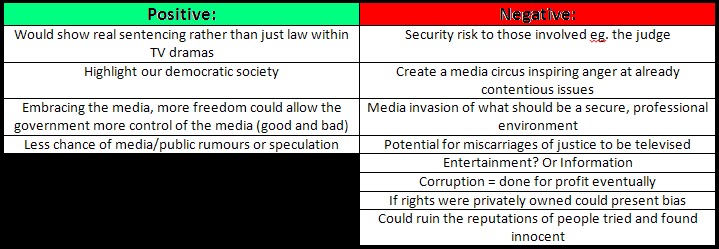
Relevant Articles In the News: 'Considering' Televising English Court Cases

News Article: BBC News UK 6th September 2011

Out-Law.com (Legal news and guidance Pinsent Masons) 6th September 2011
[References from 2 different and reliable sources]
Positive/Negative Points:
Relationship to our media-based narrative:
Ø  Media in our society seems to be gaining more power – encroaching and becoming a very powerful institution and although separate from government control/ privately owned it could sway how people think –manipulate the truth –become a ruling/consuming power of its own.
Ø  This idea has the potential to give corporations the power to manipulate society’s trust in the media, due to its influence in shaping our personal opinions on a number of issues –most especially politically – and this may also lead to the corruption of leaders who would work with the corruption to use this bias news for their advantage.
Ø  Even now the Murdock corporations highlight the dangers of biased news businesses. By present commentary and bias as fact Murdock could passively rule a large percentage of the world (4.7 billion) by selectively choosing what they know and what they don’t. Without the News Industry as the epitomy of truth and fact a nation would become a dictatorship.
Ø  We only have to look into ‘Nineteen Eighty-Four’  to see that for decades the fear that media is no longer the pinnacle of free speech that it once was is a large concern.
Our narrative is the, seeming, political backlash against the Media Industry’s abuse of power, rivalling that of the government.  We have taken this concept to an extreme to examine the issue of free speech in today’s world whilst suspending the disbelief of the viewer. Our dystopian future is where idealistic values, of removing the lying influence of the media, become corrupt anyway leading to a people’s rebellion.

Wednesday, November 9, 2011

Recent Sci-Fi/ Thriller Releases

We researched recent Sci-Fi film releases in order to understand the style of films appearing on the market, understand the audience they are marketed at and the main themes being explored at the moment. Beside each title is a small break down of the themes or key points of the film.
Inception (2010) Action, Adventure, Sci-Fi/ technology exists to enter the human mind/ highly skilled thief/last chance for redemption/ inception = plant an idea/ layers of dream worlds/ discussion of reality/ ambiguous ending  
Tron: Legacy (2010)- Action, Adventure, Sci-Fi/ set in a cyber-world – created in the first film due to advances in technology, a sequel to the first Tron (yet their storylines overlap due to the change in protagonist), father and son bond, usurping the role of God leads to a corrupt cyber-society, use of doubles, 3D
Zenith (2010) – Sci-Fi, Thriller/ retro-futuristic steam-punk thriller/ 2 men in different time periods =parallel stories/ search for a conspiracy/ big questions - the meaning of humanity

(Angels and Airwaves) Love (January 2011) – Drama, Sci-Fi/ an astronaut/ stranded in orbit on the International Space Station/ loses contact with Earth/ claustrophobic and lonely existence/ battle to maintain sanity and stay alive/ makes a strange discovery…
Iron Invader (February 2011)- Sci-Fi/ Alien Bacteria infects metal/ giant killing robot/ merging of 2 categories of Sci-fi
I am Number Four (February 2011) Action, Sci-Fi, Thriller/ 9 Alien children hiding on earth/supernatural powers/ defenders of the planet/hunted- being killed off by another race of aliens seeking to destroy them
The Adjustment Bureau (March 2011) Romance, Sci-Fi, Thriller/ mysterious interfering fate/ worldwide link of portals/ a higher power that collaborates to control the lives of people on earth
Battle: Los Angeles (March 2011) Action, Sci-Fi/ Alien attack on an American city/ military action is taken
Mars Needs Moms (March 2011) Animation, Action, Adventure/ Aliens abduct the mothers from earth/ for children/ moral centre for the story
Limitless (March 2011) – Mystery, Sci-Fi, Thriller/ top secret drug/ struggling author/ it improves brain function/ drugs race/ ambiguous ending


Paul (March 2011) - Adventure, Comedy, Sci-Fi/ 2 British geeks in American take a road trip/ alien encounter/ choose to help the alien evade authority


The Tree of Life (May 2011) - Drama, Sci-Fi/ 1950’s/ exploration of the typical family unit/ psychological evaluation of the human condition/back drop admiration of the universe/ smallness of our lives
Source Code (April 2011)- Mystery, Sci-Fi, Thriller/ soldier/ inside the body of a dead man reliving his last minutes/ bomb on a train/ mystery/technological advancement/moral issues raised/ playing with time/value of life
X-Men: First Class (June 2011)- Action, Adventure, Drama/ the evolution of humans/genetic mutation/ prejudice against the new species/ conflict/ questions of good and evil in the possession of power – choosing sides/ prequel/team =protectors of humanity
Super 8 (June 2011) - Mystery, Sci-Fi, Thriller/ film within a film/ group of children/ alien attacking small American village/ investigations/ military involvement/secrets
2012: Ice Age (June 2011)- Action, Sci-Fi/ story of a family struggle/ environmental travesty/ desolation of the world as we know it – covered with snow/ global warming/ survival of humanity at risk/ apocalypse
Transformers: Dark of the Moon (June 2011) - Action, Adventure, Sci-Fi/ conspiracy on the moon/ giant robots/good versus evil/alien technology/ lost spacecraft/government cover-ups/world domination
Phase 7 (July 2011)- Sci-Fi, Thriller/ spreading pandemic/ quarantined building/ alliances and conflict/ human desire to live/protect his own/ protagonists aim is to protect his pregnant wife/ altruism verses selfishness –the human condition/ social commentary/global crisis
Alien Armageddon (July 2011) - Sci-Fi/ aliens attack earth
Attack the Block (July 2011) - Action, Comedy, Sci-Fi/ south London/ teen gang/ alien invasion/ unlikely forging of bonds/ human nature to stick together/exploration of subtle invasion not full on war
Cowboys & Aliens (July 2011) - Action, Sci-Fi, Thriller/ set in 1873/ combining the forces of cowboys and natives against a bigger threat/ aliens/ classic hero =has the power, technology to defeat the aliens/ amnesia =self discovery/ damsel in distress
Rise of Planet of the Apes (August 2011) – Action, Drama, Sci-Fi/ scientific experiments to find the cure for Alzheimer’s/ genetically enhanced chimp = uses intelligence to bring an uprising of his species/rebellion/ prequel/ father and son story
Apollo 18 (September 2011) – Horror, Sci-Fi, Thriller/ old footage style – merging past and present storylines/ 2 American astronauts sent on a secret mission to the Moon (Apollo 18)/ terrifying events
Real Steel (October 2011) - Action, Drama, Sci-Fi/ set in the near future/ robot boxing is a top sport/ an underdog story/ father and son story
Contagion (October 2011) – Drama, Sci-Fi, Thriller/ pandemic- deadly disease/ global crisis/ following an international team of scientists = the focus/ reality of the spread of disease and fear
The Thing (October 2011) – Horror, Mystery, Sci-Fi/ remake/ Antarctic research site/ discovery of an alien craft/ deaths and chaos ensue
In Time (October 2011) – Action, Sci-Fi, Thriller/ people have predetermined length of life/ they spend their ‘time’, the years of their life, as money for food etc./ the top few are young forever and immortal/ controlled genetics/ protagonist wrongly accused of a crime – on the run/ war against the system/ dystopian future
Melancholia (November 2011) – Drama, Sci-Fi / follows the strained relationships of 2 sisters/ new planet threatening to collide with Earth/ the human condition/ point of life
The Darkest Hour (December 2011) – Action, Horror, Sci-Fi/ set in Russia/ group of young adults struggle to survive/ alien attack
The Divide (2011) - Sci-Fi, Thriller/ survivors of a nuclear attack/ human survival / apocalyptic/ claustrophobic – stuck in a basement together/dwindling supply/ exploration of the power of fear
Sol (2011) - Sci-Fi/ distant future/ hostile alien planet/ Sol Invictus competition – Earth’s academics sent to distant planet and must pinpoint out the planet’s main sun ‘Sol’/ marooned on wrong island/ band together/ human survival – Lord of the Flies-esque
Recreator (2011)- Sci-Fi, Thriller/ robots/ trio trigger a deadly experiment of the ‘Recreator’ =a scientist with a gift for cloning/ must run from clones of themselves/ avoid being replaced
The Day (2011) – Drama, Sci-Fi, Thriller/ 5 survivors/ lost and on the run/Open war against humanity rages/ global/ survival and family story/ future collapsed society
The Hunger Games (March 2012) – Action, Drama, Sci-Fi/ Post-apocalyptic society/ corrupt powers/national games to the death held in the Capitol/ a boy and a girl selected from each district/ shown on TV - part of a larger method of control/ survival/ rebellion –refusal to conform
Looper (September 2012) – Action, Sci-Fi/A killer who workd for the mob of the future recognises one of his targets as his future self/ potentially like 'Minority Report' 


Gravity (2012) –Sci-Fi, Thriller/lone survivor/ space mission to repair the Hubble telescope/ attempting to return to Earth/ mother-daughter relationship 


Upside Down (2012) – Drama, Romance/ a man searches an alternate universe for a long-lost love from his youth 


World War Z (2012) – Action, Drama, Horror/ great zombie war/ interviews survivors
Prometheus (2012) - Action, Drama, Horror/ team of explorers/ origins of mankind/ travel to the corners of the universe/ battle for humankind/ prequel
Patterns:
More eclectic selection of storylines because Sci-Fi allows for more imagination – less restricted than other genres by convention/ sci-fi often operates outside of convention constantly surprising the audience
One of the main patterns we found in the releases was Space travel or the use of different or second planets – the Sci-Fi market is predominantly linked to the idea of space and space travel. This is represented through the numerous examples of films recently released that explore either the unknown depths of space, for example setting the narrative on an alien planet, or exploring human instinct and psychology through the claustrophobic and frightening atmosphere of space. Space is the perfect location for mysteries and thrillers as these genres rely heavily on the unknown and the unseen, which is provided in abundance. ‘Apollo 18’ is a horror set on the moon which taps into the human fear of the unknown and … In a way some of these films also exhibit elements of a dystopia. Looking at ‘Sol’ for example, set a little way in the future some humans occupy a hostile alien planet. The implication is that they have left Earth for some reason and yet have found themselves in a socially corrupt civilisation. The idea of some of Earth’s population being relocated is explored in ‘Blade Runner’ whose universe includes Earth’s off-world colonies. It projects the issues related to over population, lack of resources and advanced technology into the future.
War on a global or personal scale is something explored in a few of the most recent Sci-Fi’s. We can draw the conclusion that the fascination with the psychological and social effects of war is due to the continued struggles of many countries in the Middle East including Britain. These storylines revolve heavily upon the testing of the human spirit. This convention can be found in most Sci-Fi narratives because its universal appeal and scope to allow character development, for example in 'The Day'.
Another theme is Alien Invasion films where aliens attempt worldwide domination of earth but the storyline follows a small group of individuals. These films are classic alien narratives in use for decades, however in recent year’s comedy has been merged with this genre to create a new image for these films, for example ‘Attack the Block’ and ‘Paul’. ‘Paul’ is exceptionally different from the general storyline as he is the titular role and one of the sympathetic protagonists. The war genre is often found within the traditional narrative which creates tension and pace for the race for survival. Also uncommon is the 2011 film ‘Cowboys & Aliens’ which aims to subvert audience expectation by merging two almost conflicting genres.

Disease epidemics have within recent years been in the headlines. Filmmakers have therefore produced films such as ‘Contagion’ and ‘Phase 7’ to recreate the fear and crisis point that the media reported on during the outbreak of both bird and swine flu. Interestingly ‘Contagion’ follows the group of scientists trying to develop a vaccine as well as the human interest family story. ‘Phase 7’ is about the group of people trapped in quarantine and how desperation and fear can change people.
Technological and Robotic futures were made massively commercial by the return of ‘Transformers’ to the big screen. Films such as ‘Real Steel’ and 'Recreator' play on the idea of dramatically advanced technology and both the positive and negative implications of humaniod robotics. This is very similar in theme to 'Blade Runner' particularly the narrative of 'Recreator'. Advanced technology also feed heavily into dystopian futures.
Apocalyptic and Dystopian Futures or narratives present the highly charged conflict between self preservation and altruism. Apocalyptic narratives involve global catastrophes and the reactions of the characters to them, mostly these films are Action orientated initially. Environmental, War or Zombie are just a few examples of apocalypses that might occur within a narrative. The concept is that the breakdown of a civilised society creates friction and therefore a catalyst for anarchy and humans place within the landscape of a new world order.
Dystopian plots are about societies where life is not lived in the perfect situation presented and rebellion against the system, the way things have come to be, tends to be more low-key. A communist and violent future wracked with poverty is depicted in ‘The Hunger Games’ where the people are suppressed by a game in which a group of children must fight to the death each year. In ‘In Time’ time is no longer an intangible concept it is your value and currency. Each person must live by their time and pay their way with it but it is the poor who suffer and die so that the rich may live forever. Dystopian futures take modern concerns such as genetics, technology and government corruption to create an extreme future which suspends the audience’s disbelief and creates fear.
We have followed this trend, and our narrative will be set in a dystopian future and will explore a protagonists realisation and then rebellion against the corrupt system.