.
Showing posts with label Characters. Show all posts

Tuesday, January 17, 2012

State Leaders In Life and Film

While conducting research about our antagonist - the British Prime Minister, we noticed a pattern occuring in the films we deconstructed...

Bill Clinton
US President 199

 Independance Day (1996)
President played by Bill Pullman
Pullman is white, with short hair and similar build to Clinton

The West Wing (TV Series started 1996)
President played by Martin Sheen
Sheen is white, with short hair and also has a similar build to Clinton. In this image, he is even posing in the same way with a similar background.
President Barack Obama
US President 2009 to present

 2012 (2009)
President played by Danny Glover
Glover is black, with short cropped hair and a similar build to Obama.


Prime Minister Tony Blair
UK Prime Minister 1997-2007

 The Queen (2006)
Played by Michael Sheen
In this narrative, the actor was actually playing Tony Blair.
Sheen has dark hair, a red tie, similar haircut and is white.
Prime Minister Gordon Brown
UK Prime Minister 2007-2010

 Love Actually (2003)
Played by Hugh Grant
Although the Prime Minister at the time was Gordon Brown, Hugh Grant's character seems to reflect the last publically elected Prime Minister, who was Tony Blair. Blair's popularity meant that he was more suitable to reflect within that the Romantic Comedy genre.
Grant has brown hair, is white and has a similar build to Blair.

Prime Minister David Cameron
UK Prime Minister 2010 to present

Black Mirror (TV Drama 2011)
Played by Rory Kinnear. Kinnear is white, has a similar hairstyle to Cameron, and even wears a blue tie, the Conservative party colour.

[David Cameron (Left), Nick Clegg (Middle), Jon (Right)]
We echoed this idea, our protagonist is white, has short dark hair and a similar build to our current leaders.

Friday, December 2, 2011

Death Note

Whilst there is a film adaptation of the Death Note manga series, the manga gives a stronger sense of the gritty, dystopian future that we are trying to capture. The first volume was published in 2003, but the world was set in 2006-11, giving it the Soft Sci-Fi element that we ourselves are using. Death Note is a manga created by writer Tsugumi Ohba and manga artist Takeshi Obata. The main character is Yagami Light, a high school student who discovers a supernatural notebook, the "Death Note", dropped on Earth by a god of death, or a shinigami, named Ryuk. The Death Note grants its user the ability to kill anyone whose name and face they know, by writing the name in the notebook while picturing their face. The series centers around Light's attempt to create and rule a world "cleansed of evil" as "God" using the notebook, and the efforts of a detective known as L to stop him.


LIGHT YAGAMI
Technically, Light is the protagonist of the Death Note series, but as a result of its highly complex storyline, it depends entirely on the reader’s character interpretation and beliefs as to whether he’s the protagonist, or L, Near and Mello’s antagonist. He is a highly intelligent Japanese student, disillusioned with life, who takes a chance to try and make the world into what he believes will be a better place, by killing off evil-doers as the self-declared god, Kira. The plotline follows him as his personality and morals become corrupted, and he slowly goes insane; he must kill L and L’s heirs before they can unmask him and find proof of his murderous ways.
As Light leads the world-dominating, fear-controlled dystopia, in regards to our own plot, he would be the antagonist. He fits the image of the antagonist from the other films that have deconstructed; he is a highly charismatic, highly intelligent young man who dresses smartly and manipulates and uses everyone around him to create his image of the ideal world.


L
In regards to our narrative, as Light would be considered the antagonist, L would be the protagonist. L is an eccentric recluse and the world's greatest detective. He is called upon when "Kira" starts mass-murdering, and makes it is personal quest to stop him. He spends several years working closely alongside Light in a secret battle of wits; L knows Light is Kira, and Light knows that L knows he is Kira, and so the race begins to discover who can catch other out - and kill them - first. In terms of appearance, he is not a stereotypical resistance-leader, however, one of his heirs, Mello (pictured below) fits the typecasting better. He does have the intelligence, physical capabilities and emotional detachment associated with the role though. 


Mello
As previously stated, Mello fits the "rebel" archetype much more than L; he is conventionally attractive and physically fit, emotionally detached, and with enough intelligence and a strong enough personal vendetta against the antagonist to stage an effective revolution. He also wears dark colours, leather jackets and sunglasses, superficial trademarks of the rebel archetype


Misa and Takada
Misa is Light's girlfriend and, later, fiancée, and fits the love interest archetype insofar that she wears tight, dark clothes, is conventionally attractive (she is an actress and a model) and aids Light with his cause. She is very emotional and fiercely loyal, which enables Light to horrifically manipulate her. When compared to the hyper-intelligent men she is surrounded by, she is perceived to be rather stupid and superficial, and more of a burden than helpful; however as she is an incredibly proficient actress, her perky goth "Misa Misa" personality has been widely debated to be merely an act, to avoid suspicion. Takada, the news anchor that Light begins an affair with and eventually murders, fits the archetype better as she is calm and highly intelligent, as well as being dark and conventionally attractive 


Wednesday, November 30, 2011

'1984' Film Deconstruction

1984 (1984)     Director: Michael Radford     Genre: Drama, Romance, Sci-Fi
 ‘1984’ is the film adaptation of George Orwell's novel of “a totalitarian future society in which a man whose daily work is rewriting history tries to rebel by falling in love”. The government of the totalitarian society in Oceania, Ingsoc., has perfect the means of retaining power, absolute power, for eternity. Love, Peace, Trust, Freedom, Worship and Humanity have all been distorted in the novel, all that is left is a cruel and endless hierarchy imposing poverty, fear and immorality –in short a society built on hatred where even family no longer matters. The eradication and manipulation of the past and the brutality of the Thought Police creates a horrifying dystopia, and looming over this horrific world is the face of Big Brother: ruler, dictator, idol. The audience follows Winston Smith who attempts to take back a part of his freedom and humanity by allowing himself to feel. (Click here to read about the novel)
Title:
‘1984’ is the year the protagonist, Winston Smith, believes he lives in –therefore it is the year the film is set in.
- Orwell’s suggestion?
if the totalitarian model of government wasn't discredited and abandoned, the world might look this way in 1984.
- Original novel was written in 1948, idea came from flipping the last two numbers.
- The original title for the novel was ‘The Last Man in Europe’, ‘Nineteen Eighty-Four’ was more enigmatic.
- Potentially an allusion to the poem ‘End of the Century, 1984’ by Eileen O’Shaughnessy who was Orwell’s first wife.

Due to the success of this novel the phrase ‘Orwellian’ has come to describe a totalitarian dystopia characterised by government control and subjugation of the people.
Tagline: 
‘Big Brother is watching…’
- motif of posters  throughout the film of Big Brother which bear the inscription “Big Brother is Watching You”.
- The idea of being watched creates an element of uneasiness and a pervading sense of fear.
- Epitomises the film =  the quest to allude being seen, yet it is also a core ‘truth’ in the film’s society.
The term ‘Big Brother’ has become synonymous with the idea of abuse of government power, often at the expense of civil liberty, particularly relating to mass surveillance.
Characters:
Big Brother is the embodiment of The Party who rule Oceania and is at the top of this social hierarchy. In both the novel and film it is not clear whether Big Brother is alive or dead, or even existed – some comments allude to him being merely a fictional character created to personify the Party, and used a substitute for a God or idol.
- The Party claim that he was one of the original founding members of the Party
- devotion is shown through the ‘Two Minutes Hate’ depicted in a cultish way.
Love for Big Brother is controlled and created by the three ministries: the Ministry of Peace – which deals with war,
the Ministry of Love – which is to do with surveillance and torture and
the Ministry of Truth – where propaganda and subversion of history occurs.
Costume: Big Brother’s clothing is never actually seen. His face fills the telescreen in an intimidating manner and he is only a dominating presence throughout the film and book -never met in the flesh.
Type-casting:
Big Brother has slicked back hair and a clipped moustache.
Appearance - bears a resemblance with some infamous European dictators such as Stalin and Hitler.
Age - difficult to gauge because of his features but also because his intense eyes draw the audiences’ gaze in an almost hypnotic way. He is an imposing character and, on sight, one to be feared.
It is believed that the film version Big Brother was partially inspired by the WW1 Lord Kitchener poster.
Winston is the protagonist of the film and it is through his eyes that we discover the world of 1984.
- appears to have strong moral values 
- a man of belief although he is unsure in what exactly he believes in.
- In Winston Orwell explores the concept of humanity and human instinct, whether it is inherent or whether it must be sought and through Winston’s description as the ‘last man in Europe’ the society is presented as lacking this sense of humanity and duty to one another.

Winston records his awakening to the disturbing present he lives in and the audience sees as he verbalizes and finally takes action to rebel against oppression and hatred.
Winston is revealed to be a very noble and selfless hero as he takes these life endangering steps without hope that he will live to see the change he fights for and also without knowing if anyone else will.
He struggles to be human in an environment that is designed to dehumanize. He gives up his life and eventually his soul and spirit so that he can live and think, even for a short time, as a human being, emphasising that the struggle in itself is valuable.
It is his love for Julia that allows him to have this courage and despite being isolated and broken he still believes in his own truth.
Costume: Winston
- a dirty, blue, generic jumpsuit,
- synonymous with physical labour.
- In some ways ironic, Winston strives to be different from everyone else by reclaiming his humanity and control over his feelings yet he is dressed exactly the same.
- His dress also alludes to the poverty endured by the nation.
- Whilst under torture, both physically and mentally, he is denied the human right of clean clothes in order to degrade and humiliate him.

Type-casting: John Hurt, who plays Winston, is middle-aged –fitting the description in the book, and is made to look neither ugly nor handsome.
- aligned with an everyman.
His haircut is eerily similar to George Orwell’s in the photo used for the trailer, perhaps to subtly allude to the author throughout the film.
Julia is a complex character.
- On the surface a true advocator of the Party and their principles
- underneath she rebels and rages at the injustices of the society although not on the intellectual level that Winston does.
- confident,
- sensual and
- athletic character all of which draw Winston to her, initially due to hatred because she is unattainable, at the start of their love affair.
- Her way of rebelling is by reclaiming the right to her own body and experiencing the feelings of intimacy through companionship.
- She lives the rebellion in her present and tries to convince Winston to make the most of their one life without worry about the future.
- Her feelings of self-preservation and self-confidence are greater than Winston’s, making her better adapted to active rebellion in a way that he does not have the capacity for, albeit through minor crimes.
- Both Winston and Julia believe that their hearts cannot be broken by the Party and they cling together to protect their human selves.
Costume: Julia
-  the same blue jumpsuit as Winston,
-  hers is cleaner highlighting that she hasn’t been broken by the society yet, as he has.
- no makeup
a red sash, worn around her waist. It is, ironically, to show her ‘abstinence and celibacy’; however, red is the colour of passion, love and lust.
- Winston and Julia's sexual relationship mean that they are often shown naked together. The clothes, then, become symbolic of them shedding the oppression of the society.


Type-casting: Julia
- dark hair 
- pale skin,
- just as Winston could be any man, she could be any woman.
- her youth and vitality which makes her desirable and beautiful to Winston. - Her hair is usually neatly pinned back, another way of reducing individuality and highlighting how society imposes on even the smallest details of the character’s lives.

References:
http://callcenterpurgatory.blogspot.com/2004/11/winstons-struggle.html

Thursday, November 17, 2011

Protagonist Analysis


L2R - Winston Smith from Nineteen Eighty Four, V from V for Vendetta, Cleric John Preston from Equilibrium, Deckard from Blade Runner, Detective Spooner from iRobot, Vincent Freeman from Gattaca, George Smiley from Tinker Tailor Soldier Spy, Neo from Matrix and Light Yagami from Death Note

To create an image for our protagonist, we have analysed the protagonists of media of a similar genre, and have discovered what the conventions are. To create our own effective protagonist, we will use these conventions ourselves.

ACTOR
The majority of the films we deconstructed used very high-billing, highly skilled actors to play their protagonists; as we cannot use a famous actor for our protagonist, we have decided to deconstruct their "image" to try and reproduce it ourselves.
Generally, if the film is mostly about fast-paced action and romance, the protagonist will be young, about mid-twenties, and conventionally attractive. They will have a stylish haircut and can usually be described as "tall, dark and handsome". However, Tinker Tailor Soldier Spy and Nineteen Eighty Four both have protagonists who are at least in their forties, and as a reflection, these films focus mainly on the psychological aspects of the plot, over action. The protagonist of V for Vendetta wears a mask, but his suave and cultured personality projects the image of an attractive man. As our narrative has action and
includes a romantic subplot, our protagonist will be young and attractive.


CHARACTER PERSONALITY
Although teaser trailers reveal very little of the complexities of the protagonist's personality, the basic outline of their nature is given. All of the protagonists are presented as highly intelligent, or at least of greater awareness and competance than those around them. If the narrative includes action, the protagonist will be (or will become) very skilled in whichever branch of combat they use, for example, Cleric Preston's gun-kata and V's skill with throwing knives. To lead their form of protest, the protagonist must be strong-willed, determined, and in control of his emotions, which often leads to him coming across as stoic or cold.

OUR PROTAGONIST


Our film has a romantic subplot and will involve action sequences, so we chose Luke to play our protagonist; he fits the description of "young, looks about mid-twenties and conventionally attractive". He also has dark hair and a fashionable haircut, another convention that we noticed, as well as having relatively 'closed-off' facial expressions.


Tuesday, October 11, 2011

'Blade Runner' Costume and Type-Casting

Costume:

Deckard’s style of dress:
- conforms to that of a stereotypical American detective
- resembles styles from the ‘40’s and 50’s.
- brown trench coat and coloured shirt and the way his weapon is holstered at the hip, have connotations of a Western ranger.
- old fashioned compared with the advanced technology his world.
- Deckard’s weapon although advanced in function has a retrofit look.
- generally dark or duller colours = highlight his skill for blending in.
constant motif of darkness 
- tie a symbol of professionalism, but rather than creating a sleek image for Deckard his mismatched ties show a certain scruffiness and, like the rest of his outfit, practicality.
- Over the course of the film Deckard’s appearance becomes more dishevelled, particularly directly after the fight sequences where his number of injuries are also increased.

Type Casting: Deckard’s character
- strong and silent
- moments of intense emotion (For example, the kiss scene and the final climatic fight).
- appearance connotes to strength to make his conflicts with the replicants seem plausible
- double layering of the trench coat, with its large collar and the jacket create an enhanced shoulder size and emphasise Harrison Ford’s height.
- Male protagonist chosen for this reason too,
- aggressive and emotionally detached.
- mid-brown hair and lack of distinct facial differences create the image of an ‘Everyman’ that the audience can relate to and follow.


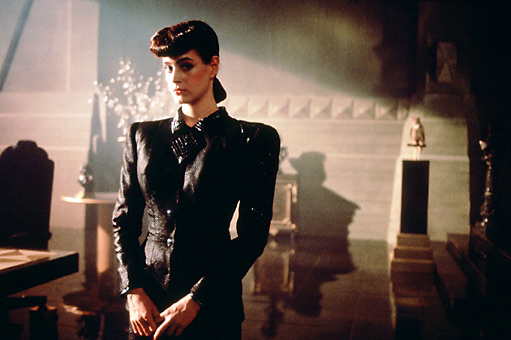
Rachael’s style of clothing:
accentuates not just her femininity
- also creates the implication that she is an android due to some of the angular lines.
- shoulder padding, use of straight lines and rigidly set hair highlight her perfect proportions.
- her demur outfits share likenesses in style to those from forties Films Noir particularly with the use of black.

**The film has acknowledged the cyclical nature of fashion but they have also altered the richness of those classic outfits to make them more rigid and mechanised.**
- high-heels are a female icon but Rachel's characteristic rhythm on the floor at Tyrell Corp. denotes to the seemingly cold and reserved side of her character. Later this sound is used to symbolise her power as she chooses a new path of her own.- Rachael’s clothing transforms, following her personal development.
- A voluminous fur coat, which has a high, stiff collar that frames her face gives her an edge of softness but also takes on an animalistic look when she kills Leon.
- the colours of her outfit  soften to a light, silk grey girlish dress with horizontal stripes and a small bow.
- most significant change in her appearance is when she lets down her hair. Her messed up curls soften her angular face and create a sense of her vulnerability. Here, with more natural make up (without the dark eyeliner and the bright red lips) she looks less like a porcelain doll and more human, ironically this is when she accepts the truth that she is a replicant.
smoking, perhaps indicating her deep need for something to rely on but also it gives her an air of mystery as often the tendrils smoke hide or blur her face.

 
Type casting: Rachel's Character
- exceptionally dark hair make her stand out from the two other women in the film, 
- highlighting her internal differences externally, 
- perhaps implying that she is ‘the dark horse’ of the film – the unexpected survivor/winner. 
- Her appearance is to exploit her beauty and present her as a desirable character. 

 
‘Blade Runner’ is a cyberpunk vision of the future and for this reason the style of the replicants (who are treated as a subservient lower class) have costumes that reflect their status.
 
Roy’s Style:
- black and grey scale clothing
- a long, reflective coat-  resembles waste. This is to convey the consumerism and post-industrial fashion of the predicted 2019.
- the coat also resembles Deckard’s with its large collar and, like Deckard’s, is worn mainly for concealment.
- the leather jacket allusion has connotations with rebels even in our society.

- Black in clothing also creates an impression of size and on Roy, who is an A grade physical model, it emphasises his size and potential strength
- creating a very imposing image.
- In contrast with the darkness of his clothing Roy has practically white hair and incredibly blue eyes
-  In the final fight scene, Roy removes most of his clothing and strips to just a pair of black shorts.
In doing so he removes the restrictions society has placed upon him becoming wilder and more animalistic in his attack. However, at the very end before his death, Roy’s near nakedness could be to imply that he was still a child (not yet 4 years old) and return him to a state of vulnerability and innocence.  The rain in this scene washes the blood from him, cleaning him, which could also support this idea.  
 
Type casting: Roy's Character
Rutger Hauer as Roy Batty
- showed both the good and evil within his character
- balanced the violence of Roy with his powerful reflections.
- The appearance of the replicants who are supposed to be superior to humans should be that of physicality, beauty and danger.
- Roy’s image is cold, Aryan and flawless in order to highlight his power,
- Tyrell even describes him as the “prodigal son”.
- The actor’s strong features and large eyes draw focus to Roy’s intense emotion.